



The names of 144 Sinti* and Roma* deported from Munich were read aloud just a few hours earlier at the Square of the Victims of National Socialism. The face of Josef Maria Schneck, a Sinto born in 1930 and murdered in 1944, was omnipresent.
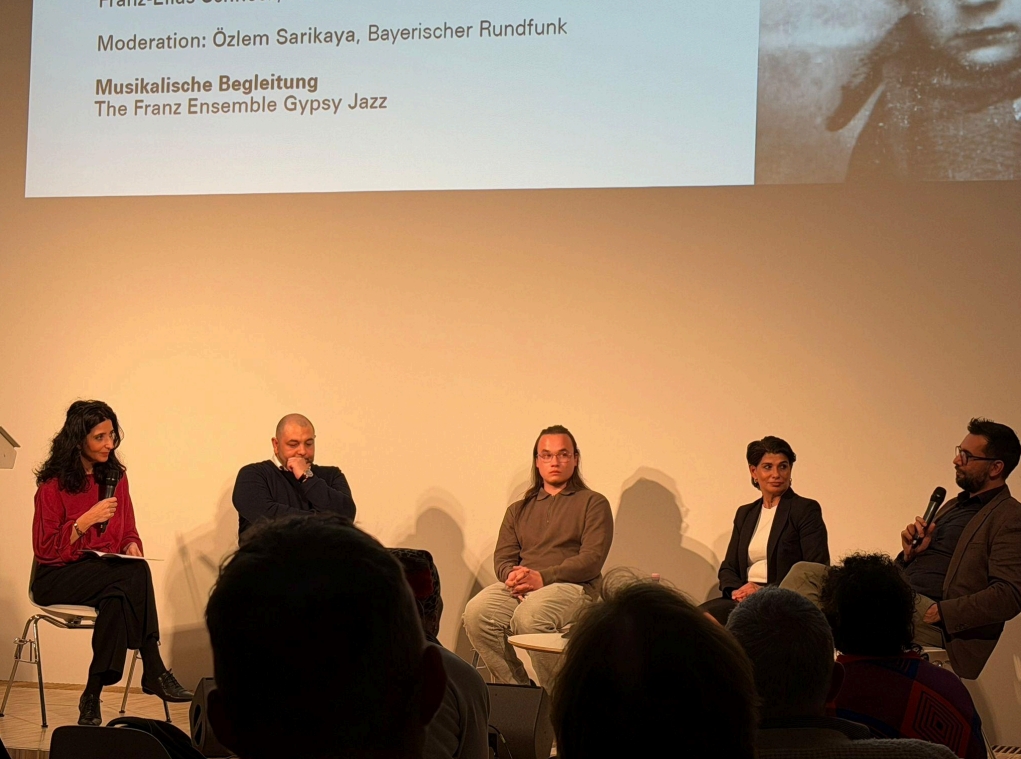
Shortly before 7 p.m., guitars, double bass, and violin from The Franz Ensemble (Gypsy Jazz) filled the space, welcoming guests to the evening commemoration at the NS Documentation Center Munich. Prof. Dr. Mirjam Zadoff, Director of the NS Documentation Center Munich, delivered the opening remarks. City Councillor Mona Fuchs, representing the Mayor of the City of Munich, emphasized the importance of the commemoration, as did Marcella Herzenberger on behalf of the Association of German Sinti and Roma, Bavarian State Association.
Franz-Elias Schneck from Pro Sinti and Roma e.V. was invited by the City of Munich to participate in the panel discussion titled “We Speak for Those Who Were Forced into Silence.” Together with Marcella Herzenberger (Regional Association of German Sinti and Roma – Swabia e.V.), Radoslav Ganev (Romanity e.V.), and Johann Mettbach (Madhouse Munich), the panel was moderated by Özlem Sarikaya (Bavarian Broadcasting).
As a descendant of the Schneck family and as a Sinto engaged in community-based counseling, he highlighted the importance of advisory centers where Sinti* and Roma* can seek free support in cases of racism—without the need to justify or explain themselves. He stressed the importance of advocacy-oriented counseling in one’s own language and pointed out that many individuals hesitate to claim their rights, as discrimination and racism are often normalized in everyday life.
In addition to a brief reflection on the history of the Württemberg Sinti family Schneck, other panelists also shared their perspectives. Johann Mettbach presented a short film by Romanity e.V. about his Holocaust-surviving grandmother and his work as a school mediator. Radoslav Ganev called for stronger involvement of young people in remembrance events and spoke about the findings of his 2025 study on Sinti* and Roma* in German higher education, addressing the struggle against antigypsyism at universities and the experiences faced by students and himself. Marcella Herzenberger also highlighted the continued persecution of Sinti and Roma in post-war Germany and underscored the achievements of the civil rights movement.
At the conclusion of the event, participants had the opportunity to engage in conversation over drinks and finger food. Many shared their concerns about the current political climate and expressed a strong desire for solidarity and togetherness.