



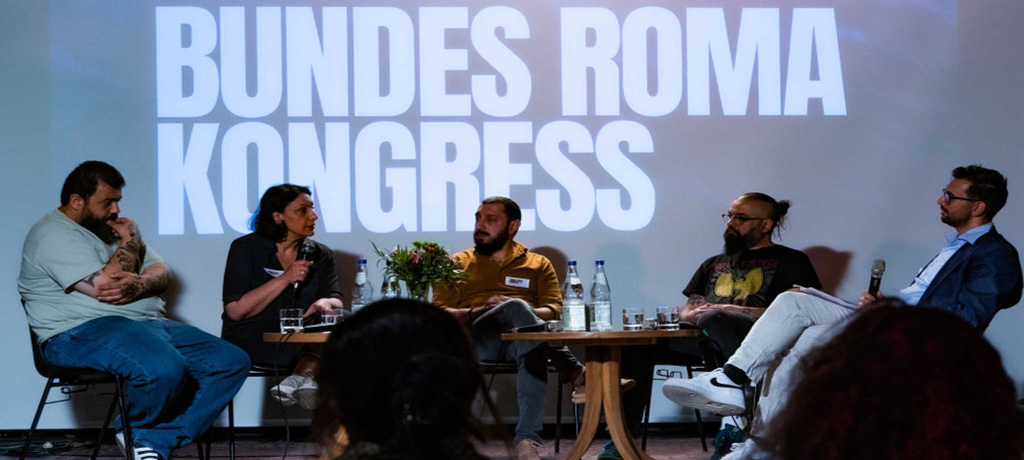
The Roma Center/Roma Antidiscrimination Network invited people to the Federal Roma Congress in Berlin from May 17 to 19. Close to Roma Resistance Day on May 16, Roma organizations from all over Germany met to discuss the current situation of the Roma community in Germany and to initiate change.
After an internal networking meeting of the organizations and other activists, we opened the congress with a panel discussion in which eight people from the organizations participated in two rounds. It was moderated by Radoslav Ganev (Romanity e.V.).

Isidora Randjelović (RomaniPhen e.V.), head of the major study "Under Suspicion", which she and her team carried out on behalf of the Independent Commission on Antigypsyism, spoke about the results of the study and the implementation of the recommendations. Experiences of racism are omnipresent in the biographies of Roma. Her study concluded with comprehensive recommendations, including measures relating to the right of residence, which are not reflected in the recommendations of the UKA report to the extent that they had been developed. Another focus was on the participation of Roma and their organizations in all areas that affect them.

Kenan Emini from the Roma Center and the Federal Roma Association spoke about the (lack of) right of residence of Roma in Germany: the reasons for long-term tolerated status, the exclusions, the structural disintegration, the deportations, “safe countries of origin”, the lack of opportunities and prospects and, above all, our proposal to implement a quota solution for those who have been tolerated for many years and Roma in forced permanent migration via Section 23 of the Residence Act.

Miman Jašarovski from With Wings and Roots spoke about the alliance Pass(t) uns Allen, of which the Roma Center is a member, and its concerns. Central to this is the demand for a citizenship and voting law adapted to the immigrant society. This would include the Ius soli, the implementation of which would mean the right of all people born in Germany to German citizenship and thus also to political rights. Exclusion from the right to vote also means that the concerns of these people do not count for politicians, because "only those who vote count".

Kjemal Ahmet from Pro Sinti and Roma spoke about the difficult situation of Roma in Baden-Württemberg. This includes the problems with the implementation of the "opportunity stay", the psychological pressure on those who have been tolerated for many years and the enormous discrimination in the institutional sector. He also pointed out the dangers for Roma of being deported if Section 24 is abolished. This is another reason why we must currently provide special support to Roma refugees from Ukraine.

Zumreta Sejdović runs the Romani Kafava, a counseling center for Roma families in Hamburg. She spoke, among other things, about the problems of Ukrainian refugees from the Roma community, who often lack support.

Jeany Seitz from the Bavarian regional association also spoke about her experience with Ukrainian Roma, their disadvantage, segregation, the experiences of discrimination and exclusion they brought with them in Ukraine, but also the problems with organizations and authorities in Bavaria.

Hamze Bytyçi spoke about society's ignorance of equal rights for Roma, about the disadvantages in the education system, including for Ukrainian Roma, and the lack of support for school mediators, as well as the lack of compensation after the Porajmos and transgenerational trauma.

Milan Raković from the Roma Information Centre spoke about the lack of solidarity, the discrimination against refugee and migrant Roma and the core problems that continue to exist and have not improved for decades.

In several contributions, the lack of a political lobby was seen as central to the implementation of positive measures, but also the lack of overarching alliances. Another problem is that although Roma organizations are sometimes asked by politicians to make statements or join committees, they often only have an alibi function and de facto nothing that the organizations consider important is implemented. At the same time, however, politicians can say that the community was involved.
The congress was an important step in bringing the organizations closer together and working together on our issues, as was the case with the World Roma Congress last year. Several speakers saw this networking as a prerequisite for working for equal rights. It would also be important to structurally support Roma organizations so that they can do their work appropriately.


The music and children's choir under the direction of Tayo Awosusi-Onutor and Dejan Jovanović caused great enthusiasm. With the "musical heritage of the Roma", they interpret songs in Romani, relate them to the present and thus bring the musical cultural heritage of the Roma closer to the audience.


Afterwards we heard the rap duo Stefan & David, whose lyrics deal with historical and current issues such as persecution and racism. The Prizreni brothers, a.k.a. Romanimuss Pryme and GIP5Y, also repeatedly allude to current issues such as the lack of residency rights in their hip hop. The grand finale of the evening was rapped by Kastro Microphone Master, the pioneer of Roma hip hop. He was persecuted in his home country because of his last album "Kastro Against White Supremacy".

At the panel discussion on the second day, we had Jana Mechelhoff-Herezi, a member of the Independent Commission on Antiziganism, as a guest, as well as the two Berlin MPs Dr. Susanna Kahlefeld (Alliance 90/The Greens) and Elif Eralp (The Left). We spoke with them about the situation of the memorial for the Sinti and Roma of Europe murdered under the Nazi regime. The construction work, which will include the felling of some of the trees belonging to the memorial, will begin in 2027. The relatives of Dani Karavan, the architect of the memorial, are currently trying to prevent damage to the site by invoking copyright law.


A second important topic was the right to remain. The Berlin Left Party recently submitted a motion to the House of Representatives that would allow Roma to remain in Germany under Section 23. However, political will in this area is very limited, even though it actually only concerns a small group of people.


The improved participation of Roma organizations was also a topic. Here it was particularly important to discuss with the state politicians what we in the other federal states can learn from Berlin. This includes, for example, the Advisory Council for Roma and Sinti Affairs, which is currently being set up and is to advise the Senate. It is an important instrument of participation.
The Independent Commission on Antigypsyism had drawn up numerous recommendations. So far, three years later, little of this has been implemented. We have been given a commissioner to combat antigypsyism, and a number of things are being developed, including the Commission on Second Persecution. We now need to actively participate in this and intervene in imbalances.


710 / 5,000
Workshops on the implementation of measures against discrimination and for the participation of Roma took place over two days, in which we were able to discuss a number of things and which we will build on. In addition, Prof. Dr. Christoph Kopke introduced us to the current situation of right-wing extremism in Germany in his workshop.
We would like to thank everyone involved for their contribution to a successful congress.
The panel discussions and the music were streamed live and can be viewed on our YouTube channel: https://www.youtube.com/@ROMADNESSStrangeMovies/streams(Opens in a new tab/window)
The streams are edited into individual clips and can then also be viewed on the channel.