



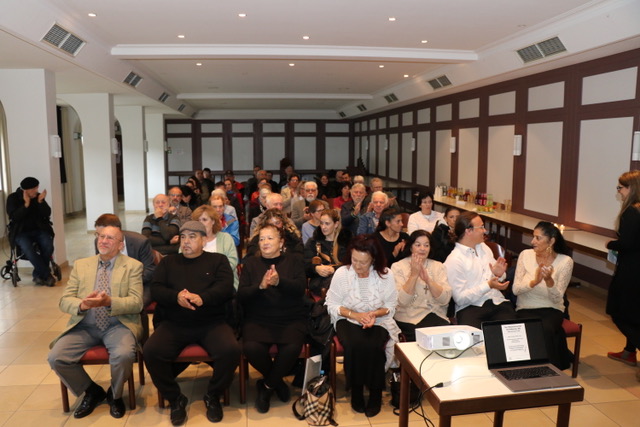
On 26 September 2025, Pro Sinti and Roma e.V., together with the Reinhardt family, invited the public to the commemorative event “The Holocaust on the Swabian Alb – Sinti Remember” in Burladingen. The event commemorated Lolo Reinhardt, the persecuted Württemberg Sinti families, and all Sintizze and Romnja who were persecuted and murdered under National Socialism. The number of victims in Europe is estimated to be between 500,000 and 1.5 million.
In a welcoming address, Mayor Davide Licht (independent) strongly emphasized the importance of commemorating the victims of the Holocaust—particularly as a reminder of the responsibility to stand up for human rights and democracy in light of the past.
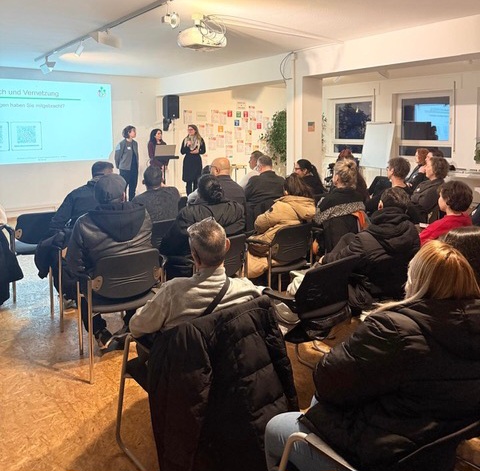
Franz-Elias Schneck, cultural studies scholar and staff member of Pro Sinti and Roma e.V., delivered a lecture on the persecution of Württemberg Sinti on the Swabian Alb. He also shared personal family memories from Deilingen-Delkhofen in the district of Tuttlingen. In the late concentration camps on the Swabian Alb, more than 2,000 Sinti and Roma were interned until the end of the war, and many were murdered. Both families (Schneck and Reinhardt) had previously lived in Renningen and left the town for the Alb region in 1938. On the designated deportation dates, family members of both families were deported from Burladingen, Ravensburg, Magstadt, and other locations.
The Burladingen Sintizza Angela Reinhardt was also mentioned, as she was one of 40 Sinti children in Mulfingen who, together with the cousins of Schneck’s father, were dehumanized and turned into research subjects by Eva Justin. Schneck concluded his lecture and the subsequent discussion with a violin performance of “Gloomy Sunday” by László Jávor.
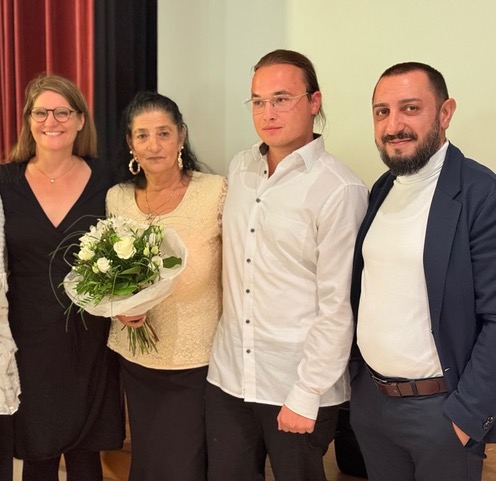
Christine Reinhardt, daughter of Lolo (Friedrich) Reinhardt (1932–1994 †), spoke in a stage conversation together with Natascha Hofmann (Deputy Chair of the association). As a second-generation Sintizza, she shared memories of the Holocaust that had been passed down to her by her father. Lolo Reinhardt’s recollections are preserved for future generations in the book “Überwintern”, published in 1999 by Bleicher Verlag, as a testimony of survivors.
Lolo Reinhardt also received much appreciation and recognition from relatives in the audience for his life and legacy. The Ziegelhütte in Burladingen-Hermannsdorf was described as a place of community for Lolo Reinhardt, Sinti families, and students from Tübingen—a place where people from different backgrounds came together. With moving and powerful words, Christine Reinhardt described how, following the death of her father—who was highly respected by his family and by fellow citizens in Burladingen—the painful loss of the Ziegelhütte as a place of life and gathering also followed, resulting in the disappearance of an important center for several Sinti families on the Swabian Alb.
She also spoke about experiences of racism in her own youth and in the lives of her children— experiences shared by many Sinti and Roma after 1945.
At the end of the event, Mamsa Reinhardt, daughter of Christine Reinhardt, performed three songs in the Spanish Sinti tradition as a tribute to her grandfather, accompanied on the accordion by Claudio Sperling.
The commemorative event was attended by around 50 people from Burladingen and the surrounding area. In addition to numerous Sinti families and interested members of the public, representatives of local politics were also present, including Katja Weiger-Schick (District Chair, SPD – Zollernalb), Annette Thriemer (Chair of the local branch of Alliance 90/The Greens), and Dörte Conradi (CDU, Burladingen City Council).
This was the first commemorative event of its kind since 2012, and it became clear how important it was for the relatives and for large parts of the town to acknowledge and honor the perspectives of those affected. In this context, Salvatore Bertolino (Chair of the ver.di trade union local association Zollernalb), in agreement with the present family members, advocated for the establishment of a memorial to commemorate the Ziegelhütte.
Addendum
The commemorative event had a tangible impact, as we learned afterward. We are particularly pleased that the event and the subsequent media coverage led to personal conversations in which appreciation, recognition, and even apologies found space. Furthermore, families from the region laid wreaths on the graves of the deceased in remembrance—an act of great significance and deep emotional impact for the descendants of the families.